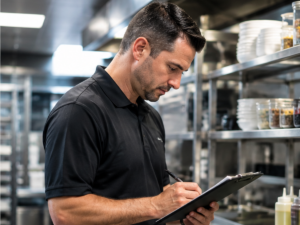
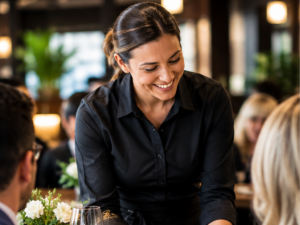
Restaurant mystery shopping measures whether your team executed the standard you built. Guest surveys measure how a self-selected group of guests felt about their visit. Both matter, but they answer completely different questions — and most operators only find out the difference after they’ve made a decision on incomplete data.
The short answer
- Mystery shopping evaluates performance against a defined operational standard: what the employee is supposed to do, what they’re supposed to say, and how long it’s supposed to take.
- Video mystery shopping does the same thing, but captures the visit on video so you can see the interaction instead of reading about it.
- Guest surveys capture guest perception. The respondent doesn’t know your standards, wasn’t trained on your service sequence, and usually isn’t a typical guest.
- The strongest programs use all of these together, not one instead of another.
What is restaurant mystery shopping?
Restaurant mystery shopping is a service evaluation method where a trained, anonymous evaluator visits your location as a guest and measures the experience against a pre-built scorecard.
The critical part is that scorecard. It isn’t generic. It’s built with the operator, and it reflects your actual service model:
- Was the guest greeted within your greet-time standard?
- Did the server offer the upsell you trained them to offer, using the language you gave them?
- Did the appetizer hit the table inside your ticket-time window?
- Was the ID check performed on the alcohol sale?
- Was the bathroom checked on the schedule your ops manual specifies?
- Was the check presented and closed within your target?
The shopper isn’t giving an opinion. They’re answering yes or no against a documented expectation, then adding narrative to explain what happened. That’s the difference between service evaluation and customer feedback.
What is video mystery shopping?
Video mystery shopping is the same evaluation, recorded. The shopper carries discreet video equipment and captures the visit from arrival through departure.
What the video adds:
- Proof instead of description. A written report says the server didn’t suggest a dessert. The video shows the moment they didn’t.
- Training material from your own restaurant. Real footage of your team, your dining room, your guests — far more useful in a pre-shift than a generic training video.
- Dispute resolution. When a GM pushes back on a score, the footage settles it in about fifteen seconds.
- Tone and body language. A written report can’t fully convey that a greeting was technically correct and emotionally flat. Video can.
- Compliance evidence. For alcohol service, age verification, and safety protocols, video creates a defensible record.
How to combine traditional and video mystery shopping
Video is the more expensive instrument, so the smartest programs don’t run it everywhere. They use traditional mystery shopping as the wide net and video as the targeted follow-up.
Traditional mystery shopping is exponentially more cost-efficient. For what a small number of video shops costs, you can run a large volume of written shops — which means more locations, more dayparts, more repetitions, and a sample size big enough to actually see patterns instead of anecdotes. If your goal is to know how 200 stores are performing across breakfast, lunch, and dinner, written shops are how you get there. Coverage is what makes the data statistically meaningful, and coverage is a function of cost per shop.
Then use video where it earns its price:
Diagnose wide, then film narrow
Run traditional shops across the portfolio at volume. When the data flags a problem — Store 214 is missing greet-time standards three months running, or a whole region is failing the upsell — send in a targeted video shop.
Now you’re not spending video budget on healthy stores. You’re spending it exactly where you already know something is broken, and you’re coming back with footage that shows the GM precisely what’s happening on their floor. That conversation goes very differently than one built on a score.
Film your best stores and build training from them
The second play is the one operators tend to overlook. Send video shoppers into your top performers — the locations already hitting standard, the servers who execute the sequence the way you drew it up.
Then splice that footage into training material. Real greeting. Real table approach. Real suggestive sell that lands. Real recovery when something goes wrong.
Why it works better than generic training video:
- It’s your concept, your menu, your uniforms, your dining room. Nobody can say “that’s not how it works here.”
- It proves the standard is achievable, because your own people are doing it.
- It recognizes your high performers, which is a retention win on top of a training one.
- It gives new hires a picture of what good actually looks like instead of a paragraph describing it.
Most programs land somewhere around high-frequency written shops across every location, with video reserved for problem diagnosis, new store openings, service resets, new menu rollouts, compliance-sensitive checks, and best-practice capture at top-performing stores.
What are guest surveys?
Guest surveys collect feedback directly from real customers, usually through a receipt invitation, QR code, email, or app prompt. They’re valuable, cheap to scale, and they capture something mystery shopping can’t: the emotional reality of your actual guest base at volume.
But they carry two structural limitations that operators need to understand.
Guest surveys don’t know your standards
A guest doesn’t know your greet-time target is 90 seconds. They don’t know your servers are trained to suggest a specific appetizer. They don’t know your ticket-time standard for a well-done steak on a Friday night.
So when a guest rates service a 3 out of 5, you learn that something felt off. You don’t learn what broke, where in the sequence it broke, or which behavior to coach. You get a symptom, not a diagnosis.
Only certain people fill out guest surveys
Survey response is self-selecting, and it skews to the extremes. The overwhelming majority of responses come from guests who were upset enough to say something — with a smaller cluster from guests who were delighted enough to say something.
The guest in the middle, the one who had a perfectly fine visit and will decide in six weeks whether to come back, almost never responds. That’s the guest whose experience actually determines your traffic trend, and they’re the least represented voice in your survey data.
Mystery shopping solves for this by design. Every shop is a controlled visit, on your schedule, at the daypart you specify, against the standard you set. The sample isn’t self-selected. It’s constructed.
Video mystery shopping vs guest surveys: side by side
| Video mystery shopping | Traditional mystery shopping | Guest surveys | |
| What it measures | Execution against your standard, on video | Execution against your standard | Guest perception and sentiment |
| Evaluator knows your standards | Yes | Yes | No |
| Sample control | Full — you set location, daypart, scenario | Full | None — self-selected |
| Response bias | Controlled | Controlled | Skews to upset and delighted guests |
| Evidence produced | Video footage plus scored report | Scored report with narrative | Ratings plus optional comments |
| Coaching value | Very high — footage usable in training | High — specific, behavior-level | Low — directional only |
| Volume | Lower (targeted) | Moderate | High |
| Cost per response | Highest | Moderate | Lowest |
| Best at answering | “What exactly happened, and can I show my team?” | “Did we execute the standard?” | “How do guests feel at scale?” |
The four-piece pie: building a complete guest experience program
This isn’t a question of mystery shopping or guest surveys. A complete restaurant guest experience program has four inputs, and each one covers a blind spot the others have.
- Mystery shopping (including video). Objective measurement against your operational standard. Tells you whether the service model you designed is actually being executed. This is your accountability layer.
- Guest surveys. Perception at volume from real customers. Tells you how the experience lands emotionally and surfaces issues you didn’t think to measure. This is your sentiment layer.
- Internal audits. The GM, RM, or district manager walking the store against a checklist — cleanliness, food safety, line checks, prep standards, back-of-house execution. Tells you about the conditions that produce the guest experience. This is your operations layer.
- Social listening and online reviews. Unfiltered public commentary from guests who never took your survey. Closely related to survey data but broader, less controlled, and consequential because prospects read it before they ever walk in. This is your reputation layer.
Run only mystery shops and you know your standards are being met but not whether the standards themselves are right. Run only surveys and you know guests are unhappy but not why. Run only internal audits and you get a version of reality filtered through the person being evaluated. Run only social listening and you’re managing the aftermath.
Together, the four give you cause and effect. The survey tells you scores dropped at Store 214 in June. The mystery shop tells you greet times slipped past two minutes on weekend dinner. The internal audit tells you the store was running two servers short. The reviews confirm guests noticed. Now you have something you can actually fix.
Frequently asked questions
Is video mystery shopping better than traditional mystery shopping?
It’s not better, it’s different — and it’s meaningfully more expensive. Traditional mystery shopping is exponentially more cost-efficient per visit, so it’s what gives you the volume and coverage needed to spot real patterns. Video produces evidence and training footage, which makes it the right tool for a targeted follow-up once written shops have flagged where the problem is, or for capturing what excellence looks like at your top locations. Use written shops to find it, video to show it.
Should restaurants replace guest surveys with mystery shopping?
No. They measure different things. Surveys capture perception at volume; mystery shops capture execution against standard. Replacing one with the other creates a blind spot rather than closing one.
How often should a restaurant be mystery shopped?
It depends on volume, concept, and how much variation exists across the portfolio. Monthly is common for full-service and casual dining, with higher frequency at underperforming locations, during new rollouts, or after a service reset.
Why do guest survey scores and mystery shop scores disagree?
Because they’re measuring different things with different samples. A location can execute your standards well and still receive poor survey scores due to factors outside the service sequence — wait times, pricing, parking, or a single vocal detractor. The disagreement itself is useful information.
What makes a good mystery shopping scorecard?
It should reflect your actual service model, use objective and verifiable criteria, weight items by business impact, and produce data you can act on. If a scorecard item can’t be coached, it probably shouldn’t be on the scorecard.
HS Brands has been designing and running mystery shopping and brand intelligence programs since 1992. We built SASSIE, the industry’s first web-based mystery shopping platform, and we run programs for restaurant, hospitality, retail, gaming, and senior living operators in more than 190 countries. If you’re trying to figure out what the right mix looks like for your concept, we’re happy to walk through it.